Welcome to Kiwi 爱AI Study. You can already chat with AI — but should you stop studying language, math, and programming?

Three abilities still earn their place: saying what you mean, thinking with structure, and building software with tests and care. AI speeds the hands — it does not replace judgment.
Each skill feeds the next: words shape the brief, math sharpens checks, code turns ideas into tools you can test.
Episode 13 showed how to finish tasks reliably; this episode asks what you still study so those habits have something solid underneath.
They are not rivals — language carries the brief, math stress-tests the logic, and code makes the result repeatable. Weaken one leg and AI still runs, but you lose leverage when answers get fuzzy.
Language: say the target precisely
First foundation: one language used well beats five used vaguely — for classmates, teachers, and the prompt box.
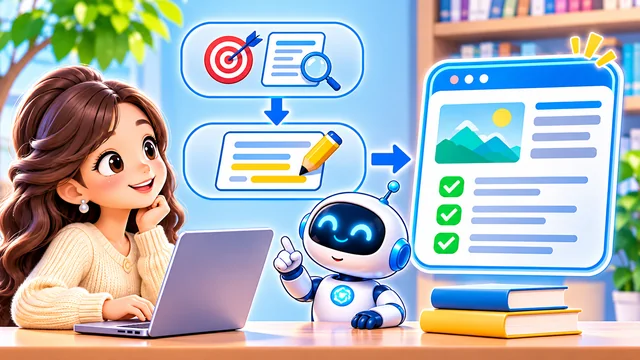
You do not need five languages on day one. Master one well enough to state goal, background, limits, and how you will judge success — with people and with AI.
“Make this page nicer” hides the real ask. Try: “Keep desktop unchanged; fix mobile title so it fits two lines without covering the character.” Specific words align everyone on the same finish line.
Episode 12’s habits — role, context, acceptance criteria — only work when your words can carry that detail. Language class and AI prompts train the same muscle.
Bilingual sites are a daily test: the same idea must land in two languages without drifting scope. That is language skill on the job — not extra languages for decoration.
Math: patterns under the hood
Second foundation: you do not need a PhD to use chatbots — but recognizing structure helps you spot nonsense faster.

Modern machine learning leans on functions, vectors, matrices, probability, and optimization. Models adjust numbers to fit patterns; chat tools still run math when they answer.
Math class also trains you to name givens, spot contradictions, compare approaches, and check conclusions. Strong math helps you understand AI ideas — but good AI use still needs domain knowledge and skeptical habits too.
Logic thinking and careful arithmetic are allies in homework and when you ask AI for a proof sketch — neither replaces the other.
When an answer includes numbers, units, or “obvious” steps, math habits ask: are the givens consistent? does the conclusion follow? That quick audit catches many model slips before you ship the work.
Code and software engineering
Third foundation: generated snippets are not a product. Engineering is what turns snippets into something you can maintain.

“AI writes code — so skip learning to program?”
Too simple. AI can scaffold pages and scripts fast. That helps beginners experiment. It does not mean requirements, security, or business rules are automatically understood.
Ask AI to build a clinic booking app and you may get a pretty form — without role permissions, conflict rules, privacy, or disaster recovery. Those needs come from people who know the work and how systems are built.
The more professional and long-lived the system, the more you must test AI output in real scenes — and know what to ask, what to check, and when not to accept the first answer.
Treat generated code like a first draft from a fast intern: useful and readable, but not merged without tests and a human who knows the domain.
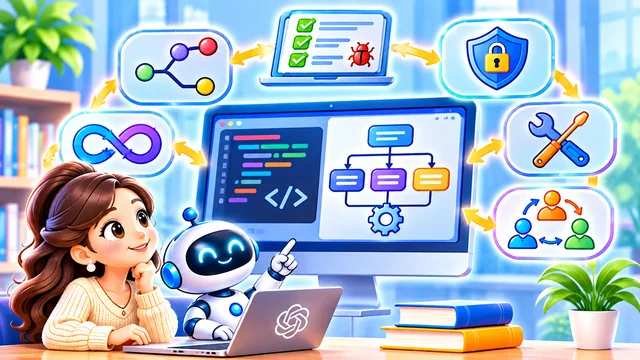
If you study programming, you can read AI output, judge algorithms, and catch edge cases. Software engineering adds requirements, architecture, testing, version control, security, and long-term upkeep.
AI can draft blueprints; a trained engineer still asks whether the structure is safe. Same for code: a few lines are not the whole product.
You do not need to be a pro developer to use AI for homework help. But if you want to build software seriously, fundamentals still matter — AI is the power tool, not the architect.
AI speeds typing; expertise still decides what to build, why the design fits, and how to prove it meets the brief.
Version control, staging sites, and regression tests feel boring until AI touches a dozen files at once — then they are how you unwind a bad pass safely.
Three skills, one toolkit

Language helps us describe problems clearly. Math helps us think them through. Software development and engineering help us design, implement, and verify solutions. AI helps us do the work faster — not skip the thinking.
Say it once for the hallway poster: clear words, careful reasoning, reliable software — then let AI accelerate each step.
Pair this episode with Episode 13: foundations explain why your asks must be precise; habits explain how you verify before you call a task done.
Next episode hosts an AI job fair — picking models and tools for the task at hand.
Takeaway: AI raises the ceiling on what you can try; language, math, and engineering raise the floor on what you can trust. Study all three so every faster workflow still has someone home who can read the output, test the numbers, and own the system.