Welcome to Episode 9 of Kiwi 爱AI Study’s AI Knowledge Class.

Last time we met Prompt. A prompt is not only an instruction—it is how people and AI communicate.
Through a prompt we tell AI what we want to do, why, what background matters, what requirements apply, and what result we hope to see.
Today’s big idea: a good prompt should be focused, not scattered in every direction at once—Focused, not Scattered.
Episode 8 named Prompt; today we ask what quality looks like—where to aim the beam so effort lands on your real task.
What focus means
What does “focused” mean—and what is “scattered”? A picture from everyday life makes the difference easy to remember.

Picture sunlight on the ground. Spread out, it can brighten a large area.
Hold a magnifying glass and squeeze that light into one tiny point—and the energy is strong enough to burn paper.
That is focus. Light going everywhere without a centre is scatter.
Prompts behave the same way: aim the beam, or let it spray.
Keep the pair Focused and Scattered in mind as you read the examples: focused pulls effort to one goal; scattered spreads guesses in many directions.
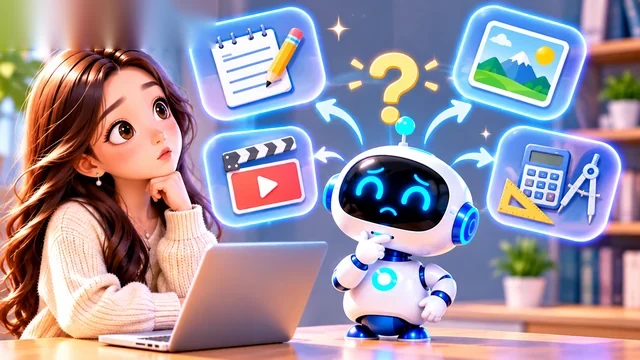
Unclear direction
You say: “Help me make something.” AI can start—but it does not know whether you want an essay, an image, a video, or a math solution. For whom? Why? What quality? So it guesses.
Scattered prompt may still produce something—but you will spend time fixing aim. Focus saves revision rounds.
That vague line—“Help me make something”—is what we mean by a direction that is not clear enough.

Focused prompt
Try: “Make a math short video for ages 10–13 on the Pythagorean theorem, about three minutes long. Keep language simple, lively, and fun—not like lecture notes.” Theme, audience, length, and tone are clear.
AI can put attention on what you actually want. That is a focused prompt.
Longer is not always better
Many beginners assume focus means “write more.” The opposite trap is length without relevance—words that never point at one goal.
Focus does not mean your prompt must be long. More words are not automatically better.
What matters is whether each detail serves the goal. Unrelated background, or many conflicting demands, can hide the main request.
A strong prompt is not padding—it is choosing the lines that help AI see the target.
Example of noise: asking for a “funny science poster” and also “formal academic tone,” or pasting three unrelated stories “for context.” Pick one main goal; park the rest for another turn.
A six-part checklist
One simple frame can help. You do not need every part every time—use what fits.
Before you send, skim the list mentally: which boxes are empty for this task?

Goal — what you want in the end. Context — what situation AI should know. Task — the concrete job. Requirements — style or quality. Constraints — what to avoid or must follow. Output — email, table, report, or script?
Sometimes one sentence is enough; sometimes a complex task needs more background. The point is not a formula—it is saying what truly matters.
On the Episode 7 map, these six ideas hang near Prompt and Context—today we practise them as a quick checklist.
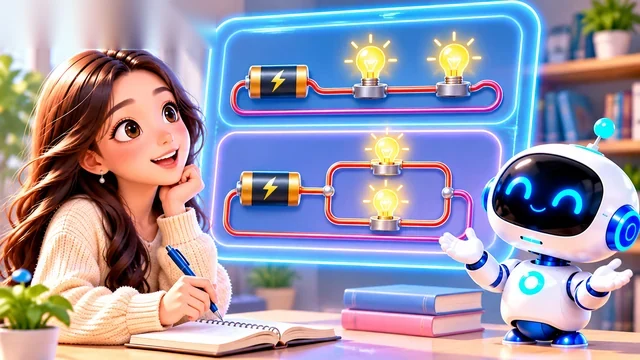
Everyday example
“Help me study science.” AI may dump random topics or ask you to narrow down.
Better: “I am in Grade 8 studying circuits. I do not understand series vs parallel. Explain with simple real-life examples, then give five practice questions with answers and brief solutions.”
Notice how Goal, Context, Task, Requirements, Constraints, and Output all appear in one short paragraph—you do not need six labeled headings every time.
AI can match the level and format you need. And a prompt is not carved in stone—if the first answer is too hard, say: “Simpler, please,” or “One more everyday example.” That back-and-forth is part of working with AI.
When answers miss the mark
Even with focus, answers can disappoint. The next section separates “bad tool day” from “unclear instructions”—and reminds us to verify.

People sometimes joke and call AI “artificially stupid.” Answers can be laughably wrong for a simple task.
Not every miss is “AI is dumb.” Sometimes the model misfires; sometimes it misunderstood; sometimes our prompt lacked context or a clear goal. AI has no mind-reading.
Before blaming the tool, ask: Did I state the goal? Miss key background? Ask for contradictory things? Adjust the prompt and try again.
The tablet picture is a fair self-test: a one-line ask gets the red mark; a clearer brief earns the green check—not because the robot changed, but because the instructions did.
Even a focused prompt does not guarantee truth. Models can still make factual, math, or made-up errors—so learn to verify answers, not only to ask well.
Learning AI is learning how to think, state needs clearly, and judge whether results are reliable.
It does not know what you thought but never typed. When a reply feels off, adjust the prompt before you label the model “broken.”
If the second try still fails after you sharpen the prompt, that is useful data too: maybe the task needs another tool, a smaller step, or a human check.
Quick audit: goal stated? context complete? contradictions removed? then verify facts either way.
Sunlight and the magnifier
We return to the opening image—same sun, different use.

Sunlight already carries energy. The magnifier does not invent new light—it concentrates what is there.
AI is powerful too. A clear, focused prompt helps you use that power on purpose.
Episode 8 gave you the reins; Episode 9 taught you to sight the flag. Next episodes add more map labels—agents, tools, workflow—but focus stays the default habit.
Takeaway: A good prompt is not necessarily longer—but the direction must be clearer.
When to scatter on purpose?
Must every prompt be tightly focused? Not always. If you are still exploring—hunting for ideas or possibilities—a looser, more open prompt can help brainstorm.
Early drafting can be scattered on purpose: “Give me five wild title ideas for a science fair project.” Later, choose one title and switch to a focused prompt for the full write-up.
When to focus, when to spread, and how to pair the two—that is worth exploring in a future lesson. For now: learn, practice, and notice the questions that appear.
See you next time—and try rewriting one vague message before Episode 10.